
Anúncio
Waterproofing before tiling creates a barrier that continues working even after it disappears beneath the floor, mortar, and ceramic. Tiles and grout help with the finish, but they should not be relied upon alone to stop water from reaching the base.
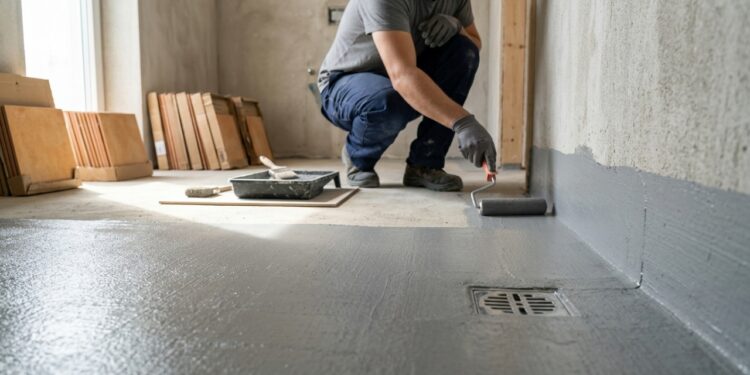
Why ceramic tiles don't replace waterproofing
A ceramic tile may have low absorption, but the finished floor has joints, edges, and interruptions. Water can find small passageways between different materials — even when the surface appears perfectly finished. Waterproofing creates another line of defence beneath that finish. Its job is to stop moisture from advancing into the subfloor, walls, slabs, or neighbouring spaces when the surface layer allows water through.
Can grout make the entire bathroom waterproof?
Grout should not be considered responsible for waterproofing the whole assembly. It fills joints between tiles and may offer different levels of water resistance, but it remains part of a segmented surface. Additionally, movement and ageing can create small cracks. Relying exclusively on grout means placing all protection in a layer that was not designed to replace the waterproofing system.
The system works in layers, not just on the surface
Base — Must be properly prepared with the required slope.
Waterproofing — Forms the continuous barrier against water passage.
Bedding — Receives the tile without damaging the protected layer.
Finish — Ceramic and grout complete the usable surface.
How to prepare your bathroom to avoid waterproofing failures
The floor needs to be levelled and sloped correctly to direct water toward the drains. Waterproofing follows this base and does not correct geometry issues that cause water to pool or flow to unwanted areas.
Joints between floor and wall, pipe penetrations, and drains require special attention because they interrupt or change the continuity of the surface. These points must be treated according to the system being used, maintaining continuous protection before the finish is installed.
What needs to be checked before tiling
The best time to fix a problem is when the waterproofing is still accessible. Once tiles are laid, any repair may require breaking tiles, mortar, and other already completed layers.
Before closing up, check:
Base regularity and cleanliness before application
Floor slope toward drainage points
Continuity at floor-to-wall junctions
Treatment of pipes passing through surfaces
Integration of waterproofing with drains
Adherence to application and curing times
Protection of the finished layer against damage from subsequent steps
Performance of the required test before tiling
Why testing after tiling is too late
Once the surface is finished, a failure remains hidden beneath tiles and mortar. Identifying its location may require progressive removal until reaching the layer that should have prevented water passage.
The cost no longer involves only waterproofing. It now includes demolition, disposal, new tiles, mortar, grout, and labour — plus the period when the bathroom remains out of use.
Visualising what will be hidden
When construction ends, the owner sees ceramic and grout but cannot observe the layer responsible for primary protection. Recording the execution before closing up can even facilitate future interventions. Pay special attention to corners, drains, and pipe penetrations — these are interruptions where the continuity of the system needs careful treatment.
What signs may appear when the system fails
Moisture on the opposite side of a wall, stains on the lower ceiling, peeling paint, and persistent deterioration may indicate water passage. However, these symptoms may also originate from plumbing installations.
Diagnosis should precede any demolition. Identifying whether the source is a pipe, drain, joint, or waterproofing failure prevents replacing finishes without solving the actual cause.
Why waterproofing before tiling cannot be skipped
Waterproofing before tiling protects what ceramic and grout cannot guarantee alone: the continuity of a barrier beneath the surface, including around drains, pipes, and changes in plane.
Preparing the base, treating the details, and verifying the system before tiling reduces the risk of discovering a failure when everything is already finished. In practice, what remains invisible is precisely one of the most important stages of any wet area.


Instalar banheira com hidromassagem em banheiro existente: quanto custa e o que muda

Leilão de apartamento: veja como checar dívidas de condomínio e IPTU antes de comprar

Reforma em 2026: quanto custa o porcelanato e por que o contrapiso é a sua maior preocupação

Promessa de orçamento baixo para rodapé pode esconder surpresa: cantos tortos e recortes elevam custo em até 5 vezes

Errar a ordem da reforma pode custar caro; veja como evitar

Azulejos velhos? Veja como modernizar o ambiente sem obra e sem sujeira
Cobrir azulejos sem quebrar nada vira tendência e promete renovar a casa com rapidez e economia.Modernizar cozinha ou banheiro já não significa enfrentar dias de barulho, poeira e entulho espalhado pela casa. Uma alternativa prática vem ganhando espaço no Brasil: aplicar novos acabamentos diretamente sobre os azulejos antigos. A proposta é simples — transformar o visual do ambiente sem recorrer à reforma tradicional.Com o avanço de materiais como massa acrílica niveladora e revestimentos sobrepo

Casa de 48 m² com piso aquecido passivo garante conforto descalço o ano todo

Como viver no centro com 28 m² e sentir que tem um dois quartos? A resposta está na marcenaria e nas portas espelhadas

Guarda-roupa, painel e bancada: quanto custa mobiliar um quarto do zero em julho de 2026 — tabela completa

Vai comprar imóvel em leilão? Veja os sinais de alerta que podem evitar grandes prejuízos

Adeus, formaldeído: sistema de drywall purificador chega para tornar sua casa mais saudável

Drywall para dividir cômodos em 2026: o que encarece (e o que barateia) a conta final


